Acids & Bases
Grade 11 acids and bases for NSC Paper 2: Arrhenius and Lowry-Brønsted theories, conjugate acid-base pairs, strong vs weak and concentrated vs dilute, neutralisation reactions, indicators and titrations, pH calculations, and stoichiometric titration calculations.
Arrhenius Theory
HCl(aq) + H2O(l) → H3O+(aq) + Cl−(aq): [H3O+] increases → HCl is an acid.
NaOH(s) → Na+(aq) + OH−(aq): [OH−] increases → NaOH is a base.
Lowry-Brønsted Theory
HCl → Cl− (lost a proton); NH3 → NH4+ (gained a proton).
∴ HCl is the acid (donor); NH3 is the base (acceptor).
Ampholytes / Amphiprotic Substances
Reacting with a base: NH3(aq) + H2O(l) → NH4+(aq) + OH−(aq): water donates a proton → acts as an acid.
Practice: strength and classification
- 1.In each reaction, label the conjugate acid-base pairs.
(a) H2SO4(aq) + H2O(l) → H3O+(aq) + HSO4−(aq)
(b) NH4+(aq) + F−(aq) → HF(aq) + NH3(aq) - 2.Classify each as a strong or weak acid, and explain your classification: sulfuric acid, hydrochloric acid, carbonic acid.
- 3.State whether each of the following can act as a Lowry-Brønsted acid or base, giving a reason.
(a) Ca(OH)2 (b) HBr - 4.Hydrogen sulfide gas, H2S, dissolves in water and donates a proton to water. Write the balanced equation and label the conjugate acid-base pairs.
- 5.Classify ammonia (NH3) as a strong or weak base, giving a reason.
- 6.Identify the conjugate acid-base pairs in: HSO4−(aq) + OH−(aq) ⇌ SO42−(aq) + H2O(l)
Strong, Weak, Concentrated, Dilute
| Strong acids | Strong bases | Weak acids | Weak bases |
|---|---|---|---|
| HCl (monoprotic) | NaOH | CH3COOH (ethanoic/acetic) | NH3 |
| HNO3 (monoprotic) | KOH | (COOH)2 (oxalic) | Zn(OH)2 |
| H2SO4 (diprotic) | LiOH | H2CO3 (carbonic) | Ca(OH)2 |
| H3PO4 (triprotic) | Ba(OH)2 | Mg(OH)2 |
Why it's wrong: they're independent. Concentrated/dilute = moles of acid/base per volume of water. Strong/weak = how completely it ionises. A weak acid can be concentrated; a strong acid can be dilute. A strong acid/base of the same concentration conducts electricity better and reacts faster, because it produces more ions.
Practice: definitions and conjugate pairs
- 1.Which ONE is the conjugate acid of HCO3−? A. CO32− B. OH− C. H2CO3 D. H3CO3
- 2.An aqueous solution that contains more hydronium ions than hydroxide ions is: A. Basic B. Acidic C. Neutral D. Amphiprotic
- 3.According to the Lowry-Brønsted theory, a base: A. dissociates in aqueous solution B. raises the OH− concentration above 10−7 mol·dm−3 C. tastes bitter and feels slippery D. accepts a proton during a collision with an acid
- 4.Which ONE of the following species cannot act as both a Lowry-Brønsted acid and base? A. H2PO4− B. H2O C. HSO4− D. CH3COOH
- 5.Consider: CH3COOH(aq) + OH−(aq) ⇌ CH3COO−(aq) + H2O(l). The correct conjugate acid-base pair is: A. CH3COOH and CH3COO− B. CH3COOH and OH− C. CH3COO− and H2O D. CH3COOH and H2O
- 6.Ammonia only partially reacts with water to produce a low concentration of OH− ions. This shows that ammonia is a: A. strong acid B. weak acid C. strong base D. weak base
- 7.Which indicator is most suitable for the titration of ethanoic acid (CH3COOH) against sodium hydroxide (NaOH)? A. Methyl orange B. Bromothymol blue C. Phenolphthalein D. Any of the above works equally well
- 8.Which ONE of the following species can act as both a Lowry-Brønsted acid and base? A. Cl− B. NH4+ C. HSO4− D. Na+
- 9.Which statement about Kw is correct? A. Kw increases as a solution becomes more acidic. B. Kw is the same at every temperature. C. Kw = [H3O+][OH−] = 1×10⁻¹⁴ at 25 °C for any aqueous solution. D. Kw only applies to solutions of strong acids.
Conjugate Acid-Base Pairs
NH3 (base 1) gains a proton → NH4+ (acid 1) → pair: NH3/NH4+
H2O (acid 2) loses a proton → OH− (base 2) → pair: H2O/OH−
Neutralisation: Definition
Acid + Metal Hydroxide → Salt + Water
Acid + Metal Oxide → Salt + Water
Acid + Metal Carbonate → Salt + Water + CO₂
Everyday Uses of Neutralisation
- Agriculture: lime (CaO / CaCO3) is added to acidic soil.
- Biology: antacids (e.g. Mg(OH)2, Al(OH)3, NaHCO3) neutralise excess stomach acid.
- Industry: limewater absorbs acidic SO2 gas released by power stations.
Practice: writing neutralisation equations
- 1.Write a balanced equation for the reaction between HNO3 and KOH.
- 2.Write a balanced equation for the reaction between HBr and K2O.
- 3.Write a balanced equation for the reaction between HCl and K2CO3.
- 4.Write a balanced equation for the reaction between H2SO4 and calcium oxide, CaO.
- 5.Write a balanced equation for the reaction between H3PO4 and magnesium hydroxide, Mg(OH)2.
- 6.Write a balanced equation for the reaction between HNO3 and calcium carbonate, CaCO3.
Titration Key Terms & Indicator Choice
| Acid | Base | Best indicator | Colour-change range |
|---|---|---|---|
| Strong | Strong | Bromothymol blue | pH 6.0 – 7.6 |
| Strong | Weak | Methyl orange | pH 3.2 – 4.4 |
| Weak | Strong | Phenolphthalein | pH 8.2 – 10.0 |
Kw and the pH Formula
\(K_w = [\text{H}_3\text{O}^+][\text{OH}^-] = 1\times10^{-14}\) at 25 °C
Neutral: [H3O+] = [OH−] = 1×10⁻⁷ mol·dm−3. Acidic: [H3O+] > 1×10⁻⁷. Basic: [H3O+] < 1×10⁻⁷.
\(\text{pH} = -\log[\text{H}_3\text{O}^+]\): a scale from 0 to 14. At Grade 11 level you only calculate the pH of strong acids and bases (complete ionisation/dissociation, so the mole ratio gives [H3O+] or [OH−] directly).
Worked Examples 8–11
1:1 ratio → [H3O+] = 0.2
pH = −log(0.2) = 0.70
1:2 ratio → [H3O+] = 0.5
pH = −log(0.5) = 0.30
[OH−] = 0.4 → [H3O+] = 10−14/0.4 = 2.5×10⁻¹⁴
pH = 13.60
[H3O+] = 10−4.5 = 3.16×10⁻⁵
[HCl] = 3.16×10⁻⁵ mol·dm−3 (1:1)
Why it's wrong: pH is a negative logarithmic scale, so more H3O+ gives a smaller pH. Compare WE8 and WE9: the more concentrated H2SO4 (0.25 mol·dm−3, diprotic) has a lower pH (0.30) than the less concentrated HNO3 (0.20 mol·dm−3, pH 0.70). Same trap in reverse for bases: more concentrated → higher pH.
HBr(aq) + H2O(l) → H3O+(aq) + Br−(aq): ratio 1:1 → [H3O+] = ____ mol·dm−3
pH = −log(____) = ____
Check your answer: pH = 1.00
Practice: pH calculations
- 1.Calculate the pH of a 0.05 mol·dm⁻³ HCl solution.
- 2.Calculate the pH of a 0.1 mol·dm⁻³ H₂SO₄ solution.
- 3.Calculate the pH of a 0.3 mol·dm⁻³ KOH solution.
Need a hint?
Hint 1: KOH is a base, so you're solving for [OH−] first, not [H3O+] directly.
Hint 2: Once you have [OH−], use Kw = [H3O+][OH−] to find [H3O+] before applying the pH formula.
- 4.A solution of HNO₃ has a pH of 2.5. Calculate its concentration.
- 5.A student must prepare 300 cm³ of a 0.2 mol·dm⁻³ KOH solution.
(a) Calculate the mass of KOH required.
(b) Calculate the pH of this solution.Need a hint?
Hint 1 (part a): Use n = cV to find the moles of KOH needed, then m = nM to convert to mass.
Hint 2 (part b): This is the same solution and concentration as WE10, but with KOH instead of NaOH. Compare your method.
- 6.Calculate the pH of a 0.1 mol·dm⁻³ H3PO4 solution, assuming complete ionisation of all three protons.
- 7.25 cm³ of a 2.0 mol·dm⁻³ HCl solution is diluted to a final volume of 500 cm³. Calculate the pH of the diluted solution.
Need a hint?
Hint: Two-step problem. First use c1V1 = c2V2 to find the new concentration after dilution, then apply the usual pH method.
- 8.A 0.2 mol·dm⁻³ solution of HCl and a 0.2 mol·dm⁻³ solution of H2SO4 are prepared separately. Calculate the pH of each, and state which is more acidic. Explain why, given equal concentrations.
Titration Toolkit
where a and b are stoichiometric coefficients of A and B, and V is always in dm³ (1 dm³ = 1000 cm³). If a reagent is in excess: ninitial = nreacted + nexcess.
Worked Examples 12–13
(0.2)(0.025)/1 = cNaOH(0.015)/1 → 0.005 = 0.015 cNaOH
cNaOH = 0.33 mol·dm−3
n(H2SO4) = cV = (0.15)(0.020) = ____ mol
Mole ratio H2SO4:NaOH = 1:2 → n(NaOH) = ____ mol
c(NaOH) = n/V = ____ / 0.024 = ____ mol·dm−3
Check your answer: c(NaOH) = 0.25 mol·dm−3
1: n(HCl)initial = (1.0)(0.050) = 0.05 mol
2: n(NaOH) = (0.5)(0.028) = 0.014 mol = n(HCl)excess
3: n(HCl)reacted with CaCO₃ = 0.05 − 0.014 = 0.036 mol
4: ratio CaCO3:HCl = 1:2 → n(CaCO3) = 0.018 mol
5: m(CaCO3) = nM = (0.018)(100) = 1.8 g
Practice: titration and stoichiometric calculations
- 1.KOH(aq) + HNO3(aq) → KNO3(aq) + H2O(l). 20 cm³ of 1.3 mol·dm⁻³ KOH is titrated with HNO₃; 17 cm³ neutralises it. Calculate c(HNO₃).
- 2.3Ca(OH)2(aq) + 2H3PO4(aq) → Ca3(PO4)2(aq) + 6H2O(l). 10 cm³ of 0.4 mol·dm⁻³ Ca(OH)₂ is titrated with H₃PO₄; 11 cm³ neutralises it. Calculate c(H₃PO₄).
Need a hint?
Hint 1: The mole ratio is not 1:1. Read it off the balanced equation: Ca(OH)₂:H₃PO₄ = 3:2.
Hint 2: n(H₃PO₄) = n(Ca(OH)₂) × 2/3
- 3.A 3.7 g sample of antacid (pure CaCO₃) is dissolved and made up to 500 cm³. A 25 cm³ sample is titrated with HCl; 20 cm³ of HCl is needed. CaCO₃(aq) + 2HCl(aq) → CaCl₂(aq) + H₂O(l) + CO₂(g). Calculate c(HCl).
Need a hint?
Hint 1: First find the concentration of the CaCO₃ stock solution (the full 500 cm³). A smaller 25 cm³ sample does not change the concentration.
Hint 2: Use that concentration with the 25 cm³ sample volume to get moles of CaCO₃ actually titrated, then apply the 1:2 ratio for moles of HCl.
- 4.25 cm³ of 0.3 mol·dm⁻³ H₂SO₄ is mixed with 25 cm³ of 0.3 mol·dm⁻³ NaOH. H₂SO₄(aq) + 2NaOH(aq) ⇌ Na₂SO₄(aq) + 2H₂O(l). Calculate the pH of the resulting mixture.
Need a hint?
Hint 1: Check whether the two reagents are actually in a 1:2 ratio as supplied. Equal volumes and concentrations does not mean the exact mole ratio the equation requires.
Hint 2: Whichever reagent runs out first is limiting, and the other is left over ("in excess"). The leftover acid or base determines the final pH.
- 5.Warm-up. 15 cm³ of 0.5 mol·dm⁻³ NaOH is exactly neutralised by 25 cm³ of HCl of unknown concentration. Calculate c(HCl).
- 6.Percentage purity. A 2.5 g impure sample of NaOH is dissolved and made up to 250 cm³. A 25 cm³ portion requires 22.5 cm³ of 0.20 mol·dm⁻³ HCl for complete neutralisation. HCl(aq) + NaOH(aq) → NaCl(aq) + H₂O(l). Calculate the percentage purity of the NaOH sample.
Need a hint?
Hint 1: Find the concentration of NaOH in the 25 cm³ sample first (same method as question 3 above), then scale up to the full 250 cm³ to get total moles of pure NaOH.
Hint 2: % purity = (mass of pure substance / mass of impure sample) × 100
- 7.Excess/back-titration. A sample of Na₂CO₃ reacts with 40.0 cm³ of 1.2 mol·dm⁻³ HCl (acid in excess). Na₂CO₃(aq) + 2HCl(aq) → 2NaCl(aq) + H₂O(l) + CO₂(g). The excess HCl is neutralised by 18.0 cm³ of 0.80 mol·dm⁻³ NaOH. Calculate the mass of Na₂CO₃ in the original sample.
Challenge questions: back-titration
Need a hint?
Hint 1: pH 12.76 is strongly basic, so decide first whether the acid or base was in excess. This tells you which species' concentration the given pH describes.
Hint 2: Convert the pH to [OH−]excess (via Kw) in the total combined volume (12 + 15 cm³) to get moles of excess base. Add this to the moles that did react (equal to moles of acid used) for the total moles of KOH in the 12 cm³ sample, then scale up to the full 250 cm³ stock.
Need a hint?
Hint: Same pattern as Worked Example 13 and question 7 of the previous section: find moles of HCl initially present, subtract the moles neutralised by the NaOH (the excess), and the remainder reacted with the CaCO₃. Convert that to a mass of pure CaCO₃, then divide by the impure sample mass.
- Definitions: Arrhenius (H₃O⁺/OH⁻ producer) vs Lowry-Brønsted (proton donor/acceptor)
- Strength: strong = ionises/dissociates completely; weak = incompletely
- Concentration: amount of acid/base per volume of water (independent of strength)
- Conjugate pairs: differ by one proton; ampholytes act as both acid and base
- Neutralisation: acid + metal hydroxide / metal oxide / carbonate → salt (+ water) (+ CO₂)
- Titrations: equivalence point vs end point; choose indicator to match acid/base strength
- pH: Kw = [H₃O⁺][OH⁻] = 10⁻¹⁴; pH = −log[H₃O⁺] (strong acids/bases only)
- Stoichiometry: n = cV, mole ratio, cAVA/a = cBVB/b, excess/back-titration
| Section | Topic |
|---|---|
| A | Definitions & conjugate pairs (MCQ) |
| B | Strength & classification |
| C | Neutralisation equations |
| D | pH calculations |
| E | Titration & stoichiometry |
| F | Challenge: back-titration |
Grade 11 Physical Sciences Paper 1 — Question 4
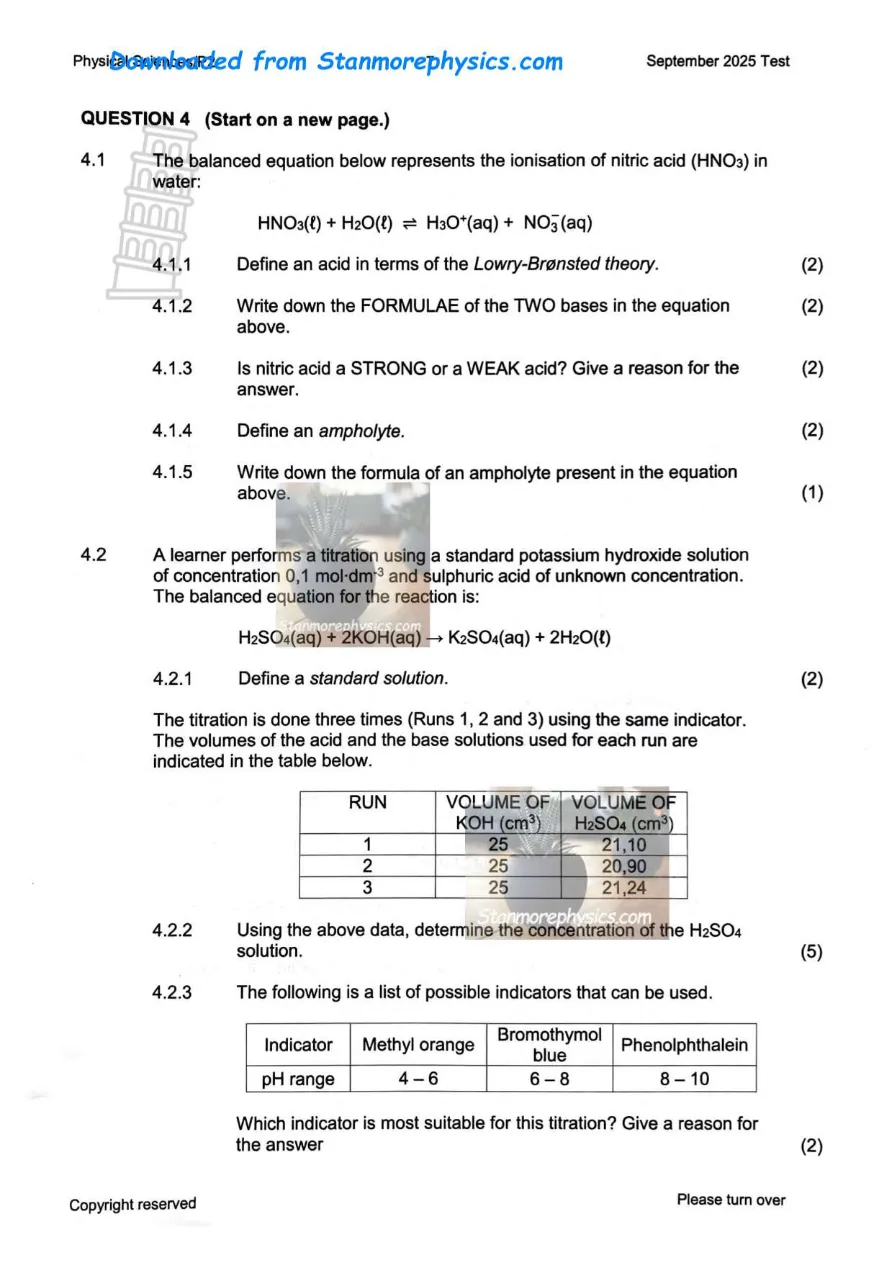
Open this question page on ExamBank → | ▶ Watch the video solution
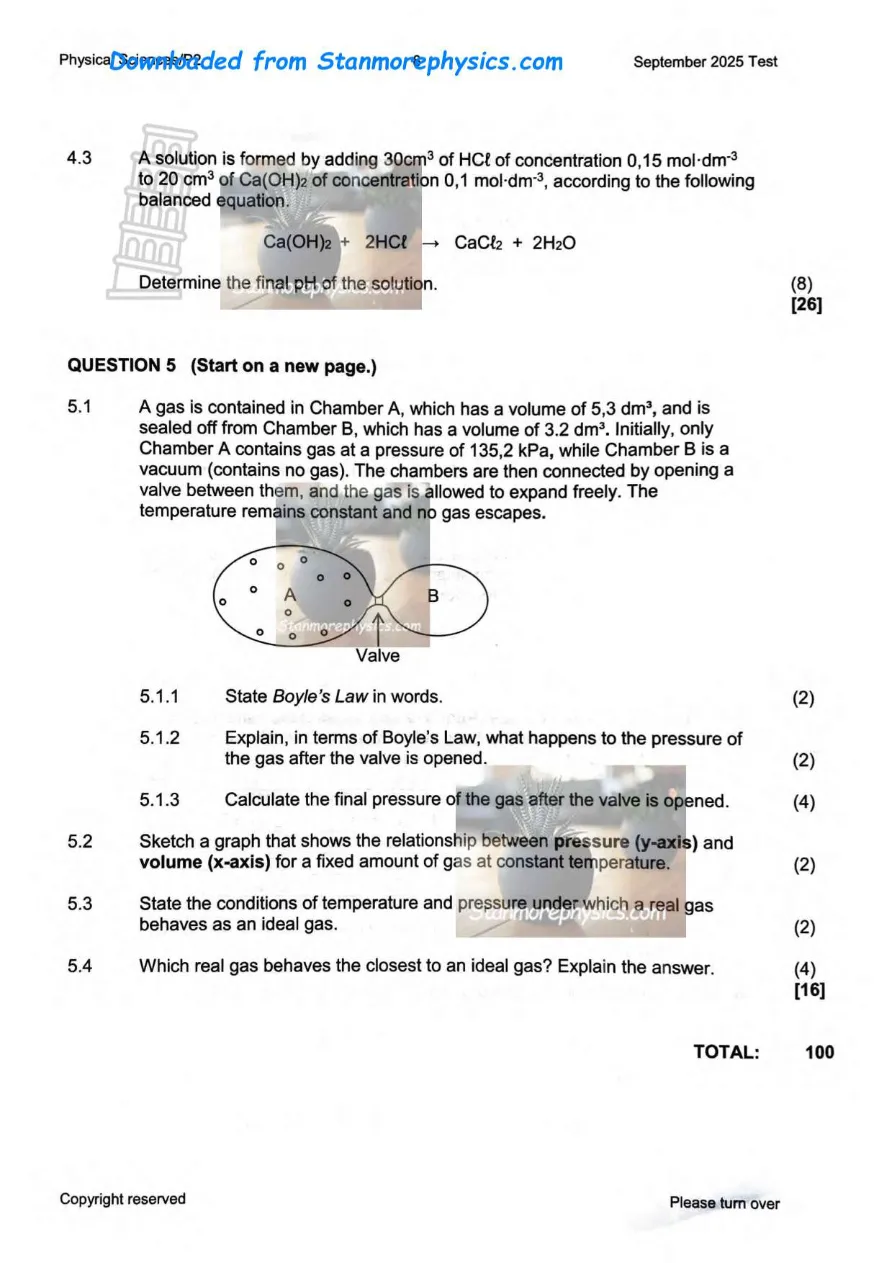
Open this question page on ExamBank → | ▶ Watch the video solution
Need a hint on 4.2.2?
This is exactly Worked Example 12's method: find n(KOH) from the average titre volume, use the 2:1 mole ratio from the balanced equation, then c = n/V for the acid.
Need a hint on 4.3?
This is an excess/back-titration problem, just like Worked Example 13: find which reagent is in excess, then use the excess concentration to get [H3O+] and pH.
Grade 12 preview
▶ Watch the video solution | Open on ExamBank →
▶ Watch the video solution | Open on ExamBank →
▶ Watch the video solution | Open on ExamBank →