Atomic Combinations
How atoms bond: electronegativity, covalent, ionic and metallic bonding, and bond energy and bond length, as examined in Paper 2.
Bond Types
Why atoms bond
Atoms form bonds to achieve a lower potential energy and a stable (full) outer electron shell, the same electron configuration as a noble gas. Bonding is always driven by the tendency to reach minimum energy.
Electronegativity (EN)
Electronegativity is the ability of an atom to attract shared electrons towards itself in a chemical bond. It increases across a period (left → right) and decreases down a group.
The ΔEN rule
Calculate the electronegativity difference between the two bonded atoms: \(\Delta\text{EN} = \text{EN}_\text{high} - \text{EN}_\text{low}\). The size of this difference determines the bond type.
ΔEN Spectrum
Cl–Cl
C–H
H–O
H–F
Mg–O
K–F
Quick Identification Rule
Non-metal + non-metal → covalent bond (share electrons)
Metal + non-metal → ionic bond (transfer electrons)
Metal + metal → metallic bond (sea of delocalised electrons)
How it forms
A covalent bond forms when two non-metal atoms share one or more pairs of electrons. Each atom contributes electrons to the shared pair, and both nuclei are attracted to the shared electrons, holding them together.
Non-polar covalent (ΔEN < 1.0)
Electrons are shared equally. No partial charges form on either atom. Examples: H₂ (ΔEN = 0), Cl₂ (ΔEN = 0), O₂ (ΔEN = 0). Also C–H bonds in organic molecules (ΔEN ≈ 0.4).
Polar covalent (1.0 ≤ ΔEN < 2.1)
Electrons are shared unequally: the more electronegative atom pulls the shared electrons closer. This creates partial charges: δ− on the electronegative atom and δ+ on the other. The bond has a dipole moment. Examples: HCl (ΔEN = 0.9), H₂O (ΔEN = 1.4), HF (ΔEN = 1.9).
Bond order
The bond order is the number of shared electron pairs between two atoms. A single bond shares 1 pair (e.g. H–Cl), a double bond shares 2 pairs (e.g. O=O), and a triple bond shares 3 pairs (e.g. N≡N). Higher bond order → stronger, shorter bond.
| Bond | Shared pairs | Example | Relative strength |
|---|---|---|---|
| Single | 1 | H–H, H–Cl |
Weakest |
| Double | 2 | O=O, C=O |
Intermediate |
| Triple | 3 | N≡N, C≡C |
Strongest |
Lewis Structures (Electron Diagrams)
In a Lewis structure, bonding pairs of electrons are shown as lines or dot-pairs between atoms. Lone (non-bonding) pairs are shown as dot-pairs around an atom. Each atom must reach 8 electrons in its outer shell (duet for H and He).
How it forms
An ionic bond forms when a metal transfers one or more valence electrons to a non-metal. The metal becomes a positive ion (cation) and the non-metal becomes a negative ion (anion). The opposite charges attract, forming the ionic bond.
Electron transfer
The metal loses electrons → forms a cation (e.g. Na → Na⁺). The non-metal gains electrons → forms an anion (e.g. Cl + e⁻ → Cl⁻). Both ions now have full outer shells.
Structure
Ionic compounds form a giant ionic lattice: a regular 3D arrangement of alternating cations and anions held together by strong electrostatic forces in all directions. There are no discrete molecules.
Example: Formation of NaCl
Na → Na⁺ + e⁻ (metal loses electron)
Cl + e⁻ → Cl⁻ (non-metal gains electron)
Na⁺ + Cl⁻ → NaCl (ionic lattice forms)
Properties Explained by Ionic Bonding
High melting/boiling point: strong electrostatic forces between ions require a lot of energy to break.
Conducts electricity when molten or dissolved: ions are free to move and carry charge.
Brittle: shifting layers aligns like charges, creating repulsion that shatters the lattice.
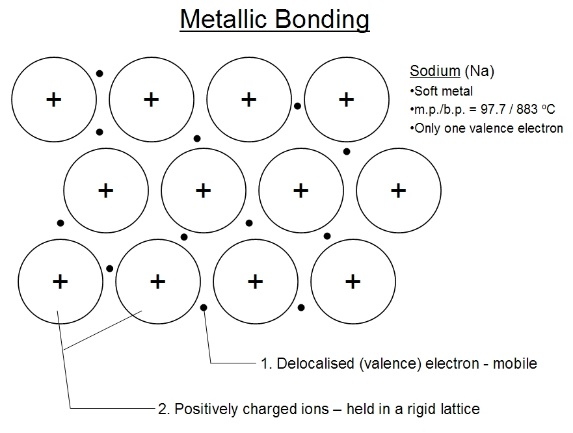
What is a metallic bond?
A metallic bond is the electrostatic attraction between positive metal kernels and a sea of delocalised (mobile) electrons. Metal atoms release their valence electrons into a shared electron sea that holds all the kernels together.
Metal kernel
A metal kernel is the nucleus plus all inner (non-valence) electrons. Because the valence electrons leave, the kernel carries a net positive charge. The kernels are arranged in a regular lattice.
Sea of electrons
The released valence electrons are delocalised: they don't belong to any specific atom and can move freely throughout the entire metal structure. This free movement explains most metallic properties.
Properties Explained by Metallic Bonding
Electrical conductivity: delocalised electrons move freely and carry charge.
Thermal conductivity: mobile electrons transfer kinetic energy rapidly through the structure.
Malleability & ductility: layers of kernels can slide over one another without breaking bonds, because the electron sea continuously re-forms the bonding.
Metallic lustre: free electrons absorb and re-emit light of many frequencies.
Bond Energy & Bond Length
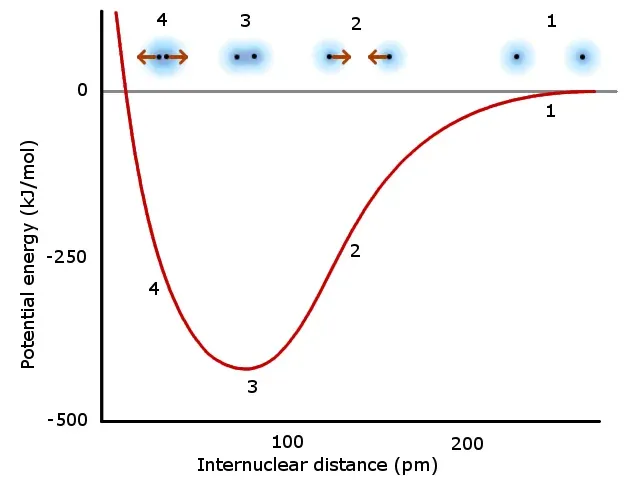
Far apart: no interaction
Atoms are far apart. There is no significant attraction or repulsion, so the potential energy is approximately zero. This is the reference level.
Approaching: attraction dominates
As the atoms move closer, the nucleus of each atom attracts the electrons of the other. The attractive force dominates and the potential energy decreases (becomes more negative).
Minimum: bond formed
The potential energy reaches a minimum. This is the most stable position. The distance at this point is the bond length. The energy needed to pull the atoms back to infinity from this point is the bond energy.
Too close: repulsion dominates
If pushed even closer, the nucleus-nucleus repulsion and electron-electron repulsion dominate. Potential energy rises steeply. The atoms cannot occupy the same space.
Reading Values from the Graph
Bond length = the internuclear distance (x-axis value) at the minimum of the curve (point 3).
Bond energy = the vertical distance from the minimum to the zero level (y-axis). It is always a positive value because it is the energy that must be supplied to break the bond.
Bond order effect
Increasing the bond order increases bond energy and decreases bond length. More shared electron pairs pull the nuclei closer together and require more energy to separate. Triple bonds are the strongest and shortest; single bonds are the weakest and longest.
Atom size effect
Larger atoms have electrons in higher energy levels, so the nuclei are further apart when bonded. Larger atoms → longer bond length → weaker bond energy. Compare: H–F (short, strong) vs H–I (long, weak).
| Bond | Type | Energy (kJ·mol⁻¹) | Length (pm) |
|---|---|---|---|
| C–C | Single | 347 | 154 |
| C=C | Double | 614 | 134 |
| C≡C | Triple | 839 | 120 |
| N–N | Single | 163 | 145 |
| N≡N | Triple | 945 | 110 |
| H–F | Single | 565 | 92 |
| H–Cl | Single | 432 | 127 |
| H–Br | Single | 366 | 141 |
| H–I | Single | 299 | 161 |
Summary Rules
Higher bond order (more shared pairs) → shorter bond length, higher bond energy.
Larger atoms → longer bond length, lower bond energy.
Bond energy and bond length are inversely related: stronger bonds are always shorter.