Equilibrium Graphs
Three types of graphs appear in NSC exams for chemical equilibrium: reaction rate vs time, concentration vs time, and number of moles vs time. Each one shows how a reversible system responds to a disturbance before settling at a new equilibrium.
Reaction Rate vs Time: Temperature Disturbance
Le Chatelier's Principle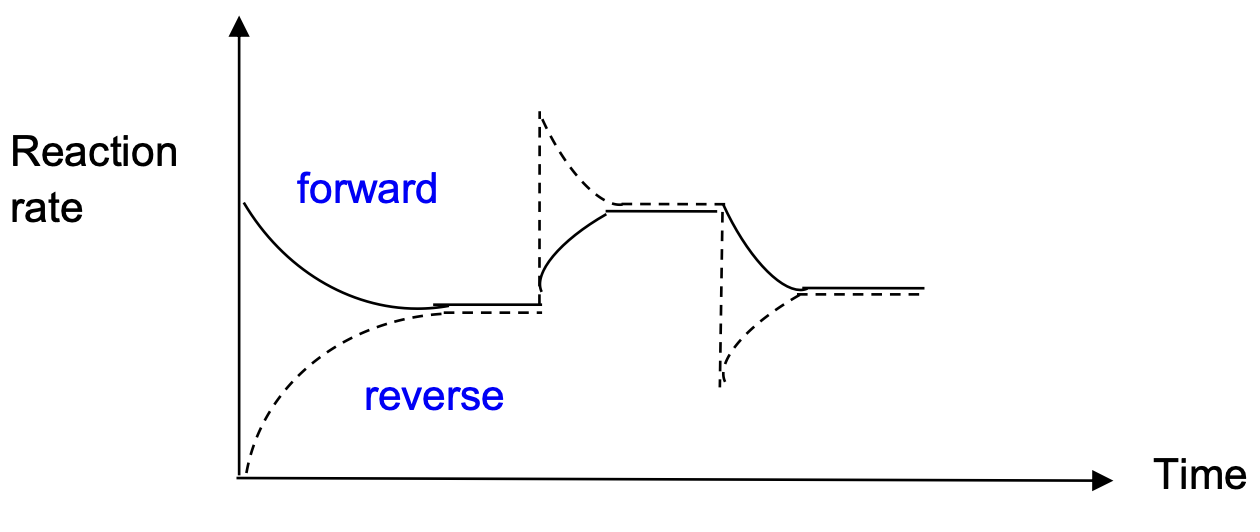
At equilibrium, forward rate = reverse rate, so the two curves are equal. The curve that changes more at a disturbance reveals the direction of shift: if the reverse increases more, the system shifts left; if the forward increases more, it shifts right.
Reaction Rate vs Time: Pressure Disturbance
Le Chatelier's Principle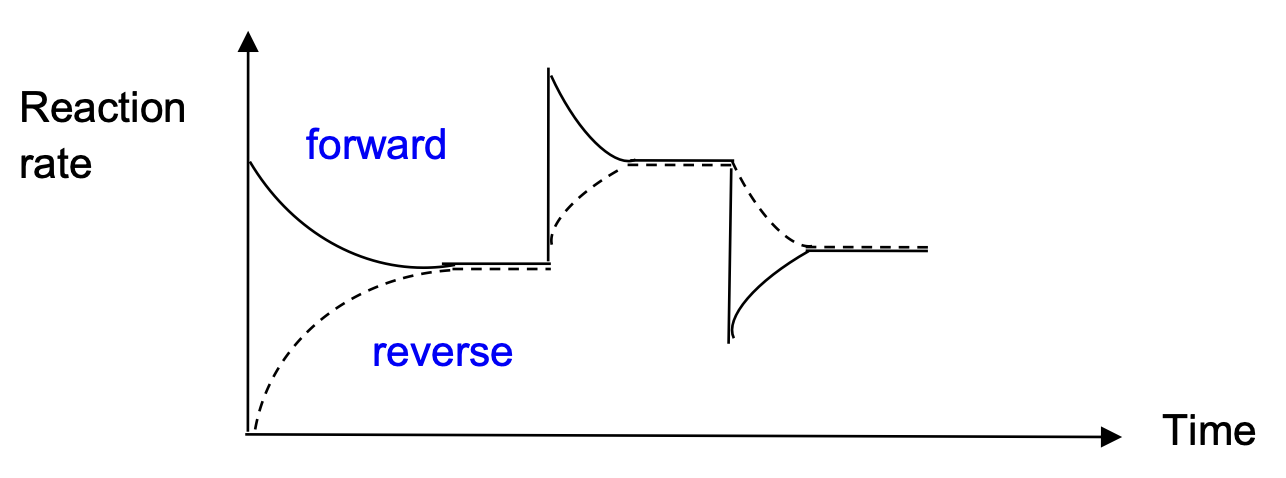
For the reaction \(\text{A}_{(g)} + 2\text{B}_{(g)} \rightleftharpoons \text{AB}_{2(g)}\): the left side has 3 moles of gas and the right has 1 mole. Increased pressure always shifts equilibrium toward the side with fewer moles of gas.
Reaction Rate vs Time: Concentration Disturbance
Le Chatelier's Principle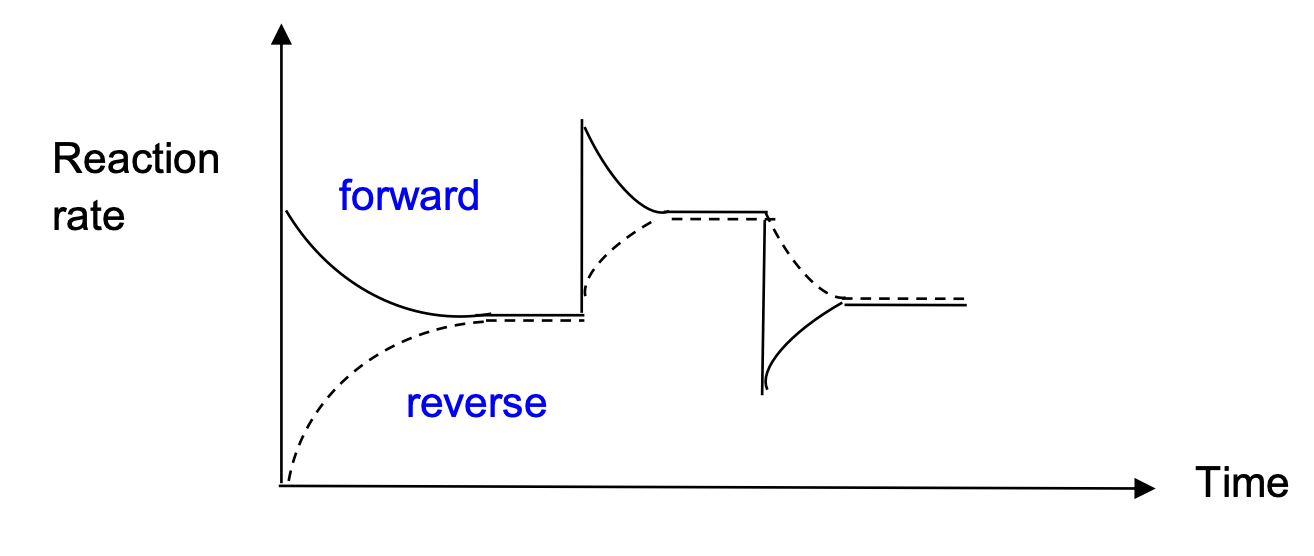
Unlike temperature and pressure, changing concentration only affects one rate immediately: the forward rate jumps when a reactant is added, or the reverse rate jumps when a product is added. The other rate catches up as the system shifts.
Reaction Rate vs Time: Catalyst Added
No shift in equilibrium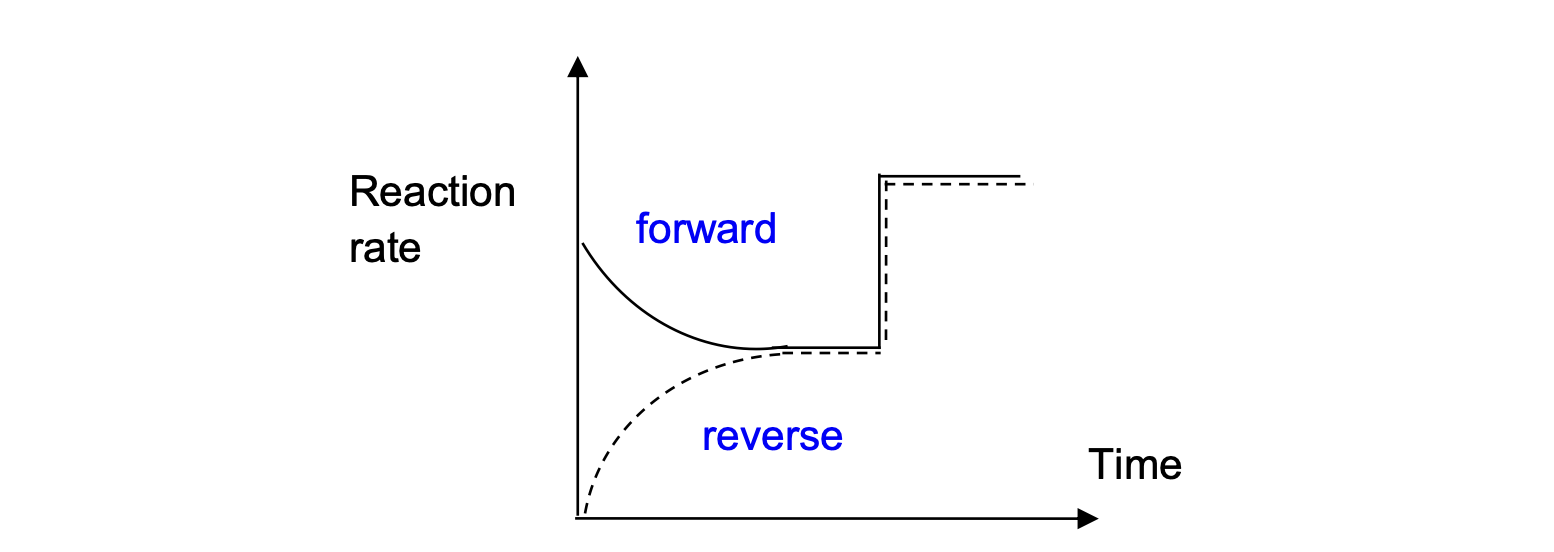
On the graph, both curves jump up by the same amount and remain equal, so the two lines stay together. This is the only disturbance where the curves do not cross or converge from different heights.
- Reactants [A] and [B]: start high, decrease as products form
- Product [C]: starts at zero, increases until equilibrium
- Flat lines: equilibrium established; concentrations constant
- Shift right → [A] and [B] decrease, [C] increases
- Shift left → [C] decreases, [A] and [B] increase
Left side: 2 moles of gas (A + B). Right side: 1 mole of gas (C). Pressure increase favours the right; pressure decrease favours the left.
Concentration vs Time: Temperature Disturbance
Le Chatelier's Principle![Concentration vs time graph showing [A], [B] and [C] responding to a temperature increase then decrease](conctimetemp.png)
Temperature is the only disturbance that changes \(K_c\). A higher temperature gives a new \(K_c\), so the flat lines after the disturbance settle at different ratios, not just shifted by a constant amount.
Concentration vs Time: Pressure Disturbance
Le Chatelier's Principle![Concentration vs time graph showing [A], [B] and [C] responding to a pressure increase then decrease](conctimepress.png)
When pressure changes by volume adjustment, all concentrations jump or drop together first (visible as a sudden step on the graph), then they shift toward the new equilibrium.
Concentration vs Time: Concentration Disturbance
Le Chatelier's Principle![Concentration vs time graph showing [A] spiking when more A is added, then all concentrations adjusting to a new equilibrium](conctimeconc.png)
On the graph, [A] shows a sudden spike when more A is added, then decreases toward the new equilibrium. [B] decreases slightly and [C] increases. Only the species directly added shows the sharp step.
Concentration vs Time: Catalyst Added
No shift in equilibrium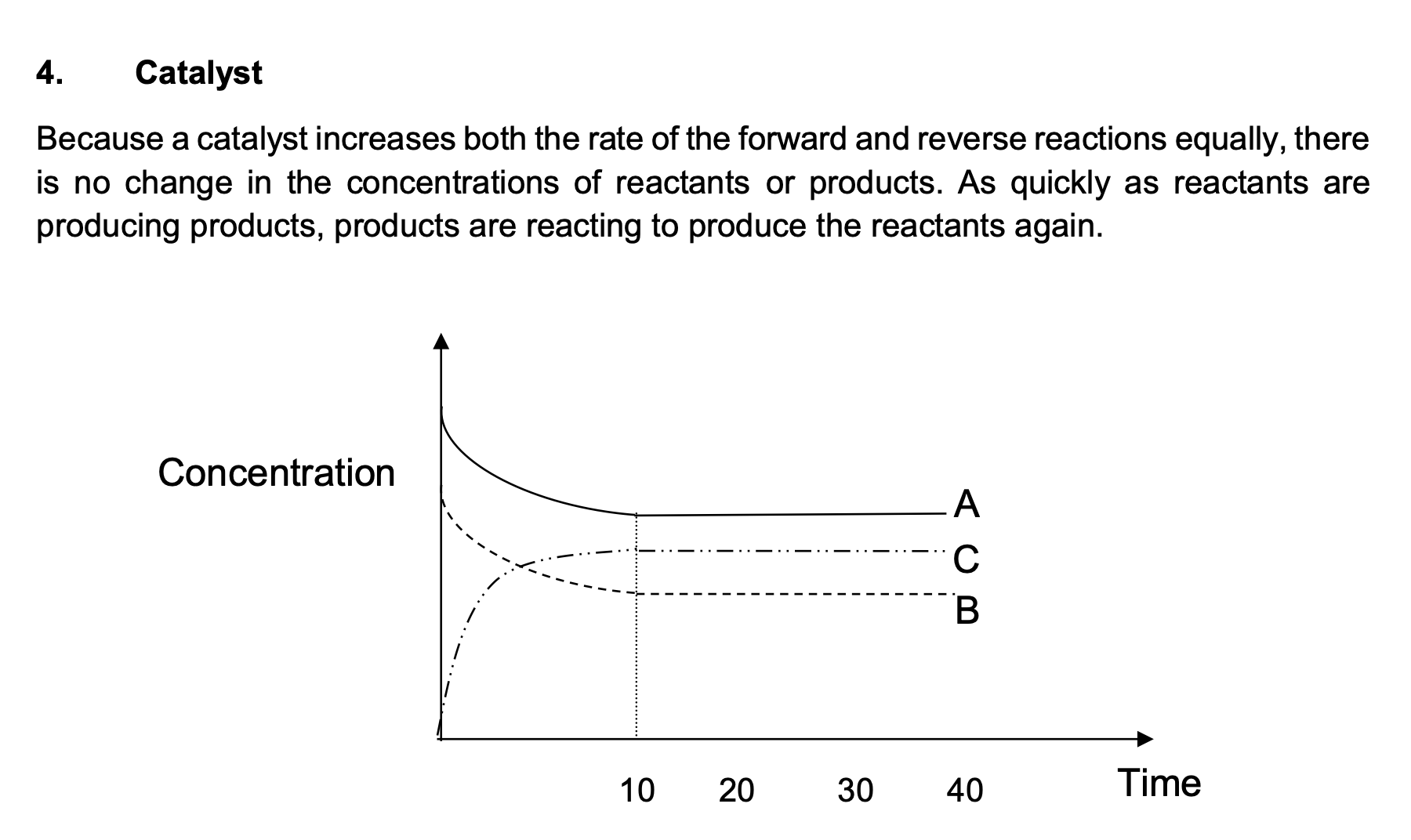
On the concentration vs time graph, adding a catalyst produces no visible change in the flat equilibrium lines: all concentrations remain exactly the same. This graph looks identical before and after the catalyst is added.