Acids & Bases
Grade 12 acids and bases for NSC Paper 2: Lowry-Brønsted theory, ionisation constants, pH, conjugate pairs, hydrolysis and acid-base titrations.
Acids & Bases
Section 1
Acid-Base Theories
Two definitions you must know: Arrhenius (limited) and Lowry-Brønsted (the one exams test).
01
Arrhenius Theory
Arrhenius Acid
A substance that produces hydrogen ions (H+) or hydronium ions (H3O+) when dissolved in water.
Arrhenius Base
A substance that produces hydroxide ions (OH−) when dissolved in water.
Limitation
- Only classifies acids and bases dissolved in water
- Cannot explain NH3 or Na2CO3 as bases: they have no OH− in their formulae, yet both form OH− in solution
- The Lowry-Brønsted theory addresses this by looking at proton transfer, not water-based definitions
02
Lowry-Brønsted Theory
Lowry-Brønsted Acid
A proton (H+) donor: any species that can give away an H+ ion to another species.
Lowry-Brønsted Base
A proton (H+) acceptor: any species that can receive an H+ ion from another species.
Examples
-
HCl acts as acid (donates H+ to water):
HCl(g) + H2O(l) → H3O+(aq) + Cl−(aq) -
NH3 acts as base (accepts H+ from water):
NH3(g) + H2O(l) ⇌ NH4+(aq) + OH−(aq)
Section 2
Acids & Bases in Water
Strong vs weak, concentrated vs dilute, monoprotic vs diprotic: these are all different concepts.
03
Ionisation vs Dissociation
A
Ionisation (acids and NH3)
Molecular substances react with water to produce ions. Written with a single arrow (→) for strong acids (complete ionisation) and a double arrow (⇌) for weak acids (partial ionisation).
Monoprotic acids release 1 H+ per molecule (HCl, HNO3).
Diprotic acids release 2 H+ per molecule (H2SO4), so [H3O+] = 2 × [acid].
Monoprotic acids release 1 H+ per molecule (HCl, HNO3).
Diprotic acids release 2 H+ per molecule (H2SO4), so [H3O+] = 2 × [acid].
B
Dissociation (metal hydroxide bases)
Ionic compounds split into their existing ions in water. Always written with a single arrow for metal hydroxides (NaOH, KOH). NH3 ionises (it is a molecule, not ionic).
Strong acid (→): HCl(g) + H2O(l) → H3O+(aq) + Cl−(aq)
Weak acid (⇌): CH3COOH(aq) + H2O(l) ⇌ H3O+(aq) + CH3COO−(aq)
Strong base (→): NaOH(s) → Na+(aq) + OH−(aq)
Diprotic acid: H2SO4(aq) + 2H2O(l) → 2H3O+(aq) + SO42−(aq)
04
Strong and Weak Acids & Bases
Acids
| Name | Formula | Strength |
|---|---|---|
| Hydrochloric acid | HCl | Strong |
| Sulphuric acid | H2SO4 | Strong |
| Nitric acid | HNO3 | Strong |
| Ethanoic acid | CH3COOH | Weak |
| Oxalic acid | (COOH)2 | Weak |
| Hydrofluoric acid | HF | Weak |
| Carbonic acid | H2CO3 | Weak |
Bases
| Name | Formula | Strength |
|---|---|---|
| Sodium hydroxide | NaOH | Strong |
| Potassium hydroxide | KOH | Strong |
| Ammonia | NH3 | Weak |
| Calcium hydroxide | Ca(OH)2 | Weak |
| Sodium carbonate | Na2CO3 | Weak |
| Sodium hydrogen carbonate | NaHCO3 | Weak |
Concentrated ≠ Strong
Strength = how completely the acid/base ionises in water. Cannot be changed in the lab.
Concentration = moles of solute per dm³ of solution. Can be changed by adding water. A strong acid can be dilute; a weak acid can be concentrated. These are independent properties.
Concentration = moles of solute per dm³ of solution. Can be changed by adding water. A strong acid can be dilute; a weak acid can be concentrated. These are independent properties.
Section 3
Conjugate Pairs & Amphiprotic Substances
In every Lowry-Brønsted reaction there are two conjugate pairs: acid 1/base 1 and acid 2/base 2.
05
Conjugate Acid-Base Pairs
Definition
A conjugate acid-base pair is two compounds or ions that differ by the presence of one H+ ion.
The conjugate base has one fewer H and one more minus charge than its acid.
The conjugate acid has one more H and one fewer minus charge than its base.
The conjugate base has one fewer H and one more minus charge than its acid.
The conjugate acid has one more H and one fewer minus charge than its base.
CH3COOH + H2O ⇌ H3O+ + CH3COO−
acid 1 base 2 acid 2 base 1
Pair 1: CH3COOH / CH3COO−
Pair 2: H3O+ / H2O
Key Rules
- Strong acid → weak conjugate base (strong acid fully ionises, conjugate base has no tendency to pick up H+)
- Weak acid → strong conjugate base (weak acid ionises little, so conjugate base readily picks up H+)
- Reactions proceed from stronger acid + stronger base → weaker acid + weaker base
06
Amphiprotic Substances
Definition
An amphiprotic (or amphoteric) substance can act as either an acid or a base, depending on what it reacts with.
Water: the classic example
- Water as base (accepts H+ from HCl):
HCl + H2O → H3O+ + Cl− - Water as acid (donates H+ to NH3):
NH3 + H2O ⇌ NH4+ + OH−
Other amphiprotic species
- HCO3−: can accept H+ (base) or donate H+ (acid)
- HSO4−: acts as acid with water, base with strong acids
- H2PO4−, HPO42−, HSO3−
Section 4
Ka, Kb and Kw
Equilibrium constants for acid ionisation, base ionisation, and the auto-ionisation of water. Higher K = more complete reaction = stronger acid/base.
07
Acid Ionisation Constant: Ka
1
Expression
For the equilibrium: HA + H2O ⇌ H3O+ + A−
\[K_a = \frac{[\text{H}_3\text{O}^+][\text{A}^-]}{[\text{HA}]}\] Water is a pure liquid and is omitted from the expression.
\[K_a = \frac{[\text{H}_3\text{O}^+][\text{A}^-]}{[\text{HA}]}\] Water is a pure liquid and is omitted from the expression.
2
Interpreting Ka values
Large Ka (e.g. >10³) → virtually complete ionisation → strong acid
Small Ka (e.g. <10⁻³) → partial ionisation → weak acid
Small Ka (e.g. <10⁻³) → partial ionisation → weak acid
Ka Values at 25 °C (weak acids)
| Acid | Formula | Ka |
|---|---|---|
| Oxalic acid (step 1) | (COOH)2 | 5.6 × 10⁻² |
| Sulphurous acid (step 1) | H2SO3 | 1.2 × 10⁻² |
| Hydrofluoric acid | HF | 3.5 × 10⁻⁴ |
| Ethanoic acid | CH3COOH | 1.8 × 10⁻⁵ |
| Carbonic acid | H2CO3 | 4.2 × 10⁻⁷ |
| Ammonium ion | NH4+ | 5.6 × 10⁻¹⁰ |
| Hydrogen carbonate ion | HCO3− | 4.8 × 10⁻¹¹ |
08
Base Constant: Kb
For the equilibrium: B + H2O ⇌ BH+ + OH−
\[K_b = \frac{[\text{BH}^+][\text{OH}^-]}{[\text{B}]}\]
\[K_b = \frac{[\text{BH}^+][\text{OH}^-]}{[\text{B}]}\]
Kb Values at 25 °C
| Base | Formula | Kb |
|---|---|---|
| Carbonate ion | CO32− | 2.1 × 10⁻⁴ |
| Ammonia | NH3 | 1.8 × 10⁻⁵ |
| Hydrogen carbonate ion | HCO3− | 2.4 × 10⁻⁸ |
| Ethanoate ion | CH3COO− | 5.6 × 10⁻¹⁰ |
09
Auto-ionisation of Water: Kw
Auto-ionisation
Water reacts with itself: H2O + H2O ⇌ H3O+ + OH−
\[K_w = [\text{H}_3\text{O}^+][\text{OH}^-] = 1 \times 10^{-14} \text{ at 25 °C}\]
\[K_w = [\text{H}_3\text{O}^+][\text{OH}^-] = 1 \times 10^{-14} \text{ at 25 °C}\]
Using Kw in calculations
- Neutral: [H3O+] = [OH−] = 1 × 10⁻⁷ mol·dm−3
- Given [H3O+], find [OH−]: \(\;[\text{OH}^-] = \dfrac{1\times10^{-14}}{[\text{H}_3\text{O}^+]}\)
- Example: 0.25 mol·dm−3 HCl → [H3O+] = 0.25
[OH−] = 1×10⁻¹⁴ / 0.25 = 4×10⁻¹⁴ mol·dm−3 - Diprotic H2SO4: [H3O+] = 2 × [H2SO4]
Section 5
The pH Scale
pH measures how acidic or basic a solution is. At 25 °C: pH 7 is neutral; below 7 is acidic; above 7 is basic.
10
pH: Definition and Calculations
Definition
\(\text{pH} = -\log[\text{H}_3\text{O}^+]\)
The negative logarithm of the hydronium ion concentration in mol·dm−3. As [H3O+] increases, pH decreases.
The negative logarithm of the hydronium ion concentration in mol·dm−3. As [H3O+] increases, pH decreases.
1
Strong monoprotic acid
[H3O+] = [acid]
Example: 0.1 mol·dm−3 HCl → pH = −log(0.1) = pH 1
Example: 0.1 mol·dm−3 HCl → pH = −log(0.1) = pH 1
2
Strong diprotic acid
[H3O+] = 2 × [acid]
Example: 0.05 mol·dm−3 H2SO4 → [H3O+] = 0.1 → pH = pH 1
Example: 0.05 mol·dm−3 H2SO4 → [H3O+] = 0.1 → pH = pH 1
3
Strong base: find pH from pOH
Find [OH−] from the base, then use Kw:
[H3O+] = Kw / [OH−], then pH = −log[H3O+]
Example: 0.01 mol·dm−3 NaOH → [OH−] = 0.01
[H3O+] = 10−14/0.01 = 10−12 → pH = pH 12
[H3O+] = Kw / [OH−], then pH = −log[H3O+]
Example: 0.01 mol·dm−3 NaOH → [OH−] = 0.01
[H3O+] = 10−14/0.01 = 10−12 → pH = pH 12
4
Weak acid: use Ka with RICE table
Cannot assume [H3O+] = [acid]. Must use Ka and solve: \(K_a = \dfrac{x^2}{c - x}\) (where x = [H3O+]).
If Ka is very small, approximate: \(x \approx \sqrt{K_a \times c}\)
If Ka is very small, approximate: \(x \approx \sqrt{K_a \times c}\)
Section 6
Reactions of Acids
Acids react with metals, bases, metal oxides, and carbonates, always producing a salt. Know the general equations and be able to write balanced equations for any combination.
11
Acid + Metal
General equation
Acid + Metal → Salt + Hydrogen gas
2HCl(aq) + Zn(s) → ZnCl2(aq) + H2(g)
H2SO4(aq) + Mg(s) → MgSO4(aq) + H2(g)
6HCl(aq) + 2Al(s) → 2AlCl3(aq) + 3H2(g)
12
Acid + Base (Neutralisation)
General equation
Acid + Base (metal hydroxide or ammonia) → Salt + Water
HCl(aq) + NaOH(aq) → NaCl(aq) + H2O(l)
H2SO4(aq) + 2NaOH(aq) → Na2SO4(aq) + 2H2O(l)
HCl(aq) + NH3(aq) → NH4Cl(aq)
13
Acid + Metal Oxide
General equation
Acid + Metal Oxide → Salt + Water
(Metal oxide acts as a base)
(Metal oxide acts as a base)
2HCl(aq) + ZnO(s) → ZnCl2(aq) + H2O(l)
H2SO4(aq) + MgO(s) → MgSO4(aq) + H2O(l)
6HCl(aq) + Al2O3(s) → 2AlCl3(aq) + 3H2O(l)
14
Acid + Carbonate
General equation
Acid + Carbonate (or Hydrogen Carbonate) → Salt + Water + Carbon dioxide
2HCl(aq) + Na2CO3(s) → 2NaCl(aq) + H2O(l) + CO2(g)
H2SO4(aq) + CaCO3(s) → CaSO4(aq) + H2O(l) + CO2(g)
HCl(aq) + NaHCO3(s) → NaCl(aq) + H2O(l) + CO2(g)
Section 7
Neutralisation & Hydrolysis
Neutralisation is not always pH 7. It depends on what salt forms. Hydrolysis explains why.
15
Neutralisation: pH at the Equivalence Point
Neutralisation
A chemical reaction in which an acid and a base react so that neither is in excess. Products are a salt and water.
pH at Equivalence
| Acid | Base | Salt formed | pH at equiv. |
|---|---|---|---|
| Strong (HCl) | Strong (NaOH) | NaCl: neutral | pH = 7 |
| Weak (CH3COOH) | Strong (NaOH) | CH3COONa: basic | pH > 7 (~9) |
| Strong (HCl) | Weak (NH3) | NH4Cl: acidic | pH < 7 (~5) |
Why isn't it always 7? Because the salt that forms dissolves in water and undergoes hydrolysis, producing a slight excess of H3O+ or OH−.
16
Hydrolysis: The 4-Step Method
Definition
Hydrolysis is the reaction of an ion from a salt with water, which alters the pH of the resulting solution.
1
Identify the ions and their sources
Split the salt into its ions. For each ion, identify whether it comes from a strong or weak acid/base.
2
Decide which ion hydrolyses
An ion from a strong acid or strong base does not undergo hydrolysis.
An ion from a weak acid or weak base does undergo hydrolysis.
An ion from a weak acid or weak base does undergo hydrolysis.
3
Write the hydrolysis equation
The ion reacts with H2O.
If it accepts H+ (base ion): produces OH−
If it donates H+ (acid ion): produces H3O+
If it accepts H+ (base ion): produces OH−
If it donates H+ (acid ion): produces H3O+
4
Determine the pH
OH− produced → solution is basic (pH > 7)
H3O+ produced → solution is acidic (pH < 7)
H3O+ produced → solution is acidic (pH < 7)
Worked Examples
NH4Cl: Acidic salt
Ions: NH4+ (from weak base NH3) and Cl− (from strong acid HCl)
Cl− does not hydrolyse. NH4+ hydrolyses:
NH4+(aq) + H2O(l) ⇌ NH3(aq) + H3O+(aq)
→ H3O+ produced → pH < 7 (acidic)
Cl− does not hydrolyse. NH4+ hydrolyses:
NH4+(aq) + H2O(l) ⇌ NH3(aq) + H3O+(aq)
→ H3O+ produced → pH < 7 (acidic)
NaHCO3: Basic salt
Ions: Na+ (from strong base NaOH) and HCO3− (from weak acid H2CO3)
Na+ does not hydrolyse. HCO3− hydrolyses:
HCO3−(aq) + H2O(l) ⇌ H2CO3(aq) + OH−(aq)
→ OH− produced → pH > 7 (basic)
Na+ does not hydrolyse. HCO3− hydrolyses:
HCO3−(aq) + H2O(l) ⇌ H2CO3(aq) + OH−(aq)
→ OH− produced → pH > 7 (basic)
NaCl: Neutral salt
Ions: Na+ (strong base NaOH) and Cl− (strong acid HCl)
Neither ion hydrolyses → pH = 7 (neutral)
Neither ion hydrolyses → pH = 7 (neutral)
Section 8
Acid-Base Titrations
Titrations measure unknown concentrations. Three things determine a titration: the right indicator, careful procedure, and a stoichiometric calculation.
17
Choosing the Right Indicator
Rule
Choose an indicator whose colour-change range spans the equivalence point pH. The indicator must change colour sharply at that exact point.
| Indicator | Acid colour | Base colour | pH range | Use for |
|---|---|---|---|---|
| Bromothymol blue | Yellow | Blue | 6.0 – 7.6 | Strong acid + Strong base |
| Phenolphthalein | Colourless | Pink | 8.3 – 10.0 | Weak acid + Strong base |
| Methyl orange | Red | Yellow | 3.1 – 4.4 | Strong acid + Weak base |
| Methyl red | Red | Yellow | 4.8 – 6.0 | Strong acid + Weak base |
Why the indicator acts as an indicator
Indicators (HIn) are weak acids where HIn and In− have different colours. In acidic solution, excess H3O+ shifts equilibrium left → HIn colour. In basic solution, equilibrium shifts right → In− colour.
18
Titration Procedure & Key Terms
Key Definitions
Standard Solution
A solution of precisely known concentration. Also called a primary standard.
Equivalence Point
The point where equivalent amounts of acid and base have reacted, so neither is in excess.
End Point
The point where the indicator changes colour. Ideally matches the equivalence point.
Titrant
The solution added from the burette.
Titrand
The solution in the conical flask (with indicator).
Equipment
- Burette (for titrant)
- Funnel (to fill burette)
- Pipette (to measure titrand)
- Conical (Erlenmeyer) flask
- Volumetric flask (to prepare standard solution)
- White tile (to see colour change clearly)
- Wash bottle (de-ionised water)
- Appropriate indicator (3–5 drops)
Tip
A titre of 30–35 cm³ is ideal because it keeps the percentage error in volume measurement low.
19
Titration Calculations
Formulae
\(n = c \times V \qquad c = \dfrac{n}{V}\)
Always convert cm³ to dm³: divide by 1000.
E.g. 44 cm³ = 0.044 dm³
Always convert cm³ to dm³: divide by 1000.
E.g. 44 cm³ = 0.044 dm³
1
Write a balanced equation
Identify the mole ratio between acid and base from the equation.
2
Calculate moles of the known substance
\(n = c \times V\) using the concentration and volume of the standard solution.
3
Use the mole ratio
Scale moles of the unknown substance using the ratio from the balanced equation.
4
Calculate the unknown concentration
\(c = \dfrac{n}{V}\) using moles from step 3 and the volume of the unknown solution.
Worked Example
44 cm³ of HCl (0.15 mol·dm−3) neutralises 38 cm³ of Ba(OH)2.
Equation: 2HCl + Ba(OH)2 → BaCl2 + 2H2O
n(HCl) = 0.15 × 0.044 = 0.0066 mol
n(Ba(OH)2) = 0.0066 / 2 = 0.0033 mol (ratio 2:1)
c(Ba(OH)2) = 0.0033 / 0.038 = 0.087 mol·dm−3
Equation: 2HCl + Ba(OH)2 → BaCl2 + 2H2O
n(HCl) = 0.15 × 0.044 = 0.0066 mol
n(Ba(OH)2) = 0.0066 / 2 = 0.0033 mol (ratio 2:1)
c(Ba(OH)2) = 0.0033 / 0.038 = 0.087 mol·dm−3
Section 9
pH Titration Curves
The shape of the pH curve and the pH at the equivalence point depend on whether the acid and base are strong or weak. Both directions are shown: acid running into base, and base running into acid.
20
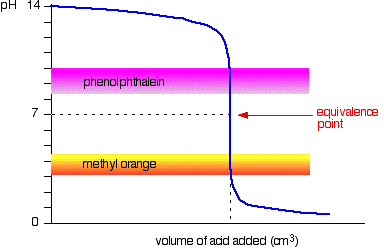
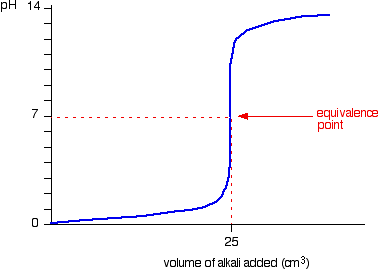
Strong Acid + Strong Base
Acid running into base
Base running into acid
→
Shape
S-shaped curve with a steep vertical section at the equivalence point. The jump in pH spans several units very rapidly near the equivalence point.
→
Equivalence point
pH = 7: the salt formed (e.g. NaCl) does not hydrolyse, so the solution is neutral.
→
Indicator
Bromothymol blue (pH range 6.0–7.6): any indicator that changes colour near pH 7 is suitable. Phenolphthalein and methyl orange also work because the steep section covers their ranges.
21
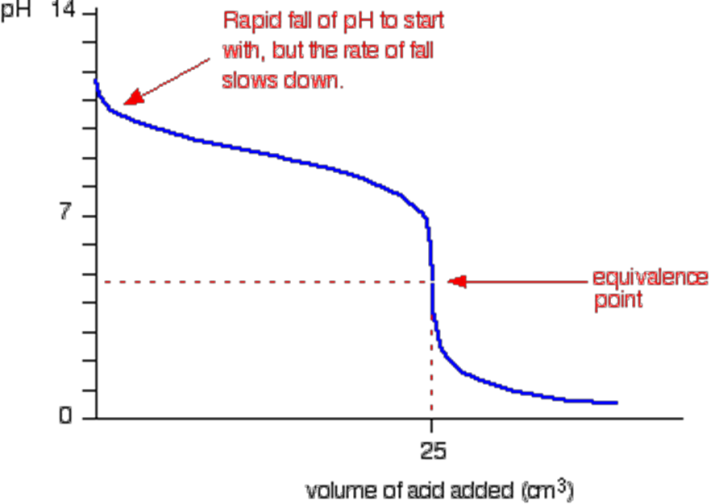
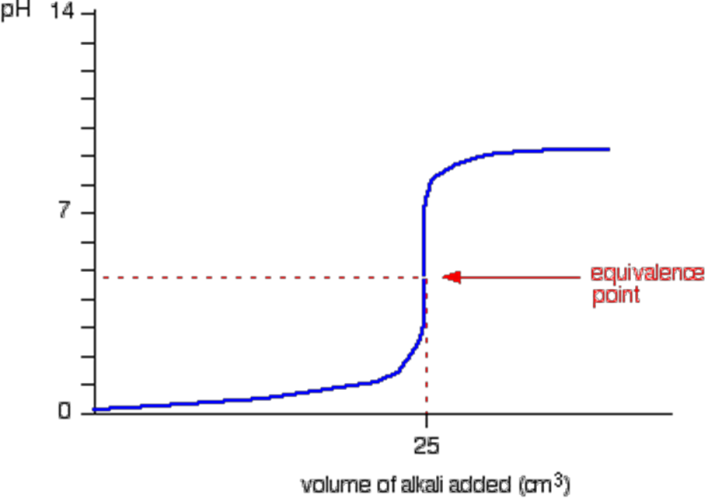
Strong Acid + Weak Base
Acid running into base
Base running into acid
→
Shape
The steep section is shorter and the equivalence point jump is less pronounced than in a strong + strong titration. The curve levels off more gradually on the base side.
→
Equivalence point
pH < 7 (approximately pH 5): the salt formed (e.g. NH4Cl) undergoes hydrolysis, producing excess H3O+.
→
Indicator
Methyl orange (pH 3.1–4.4) or methyl red (pH 4.8–6.0): must change colour in the acidic region. Phenolphthalein is not suitable here.
22
Weak Acid + Strong Base
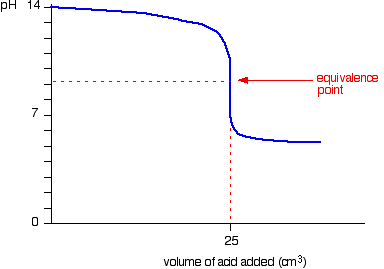
Acid running into base
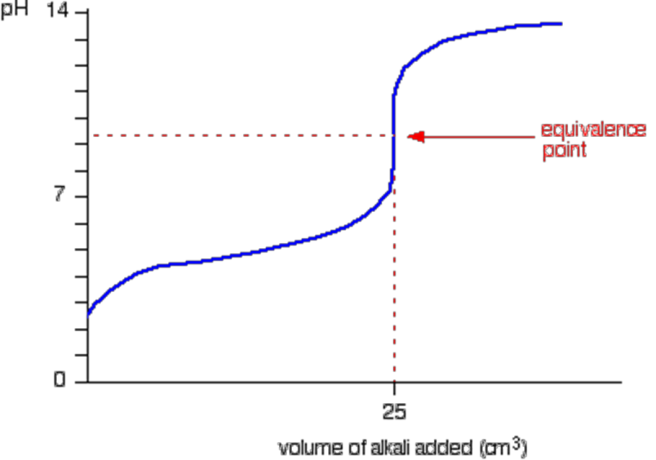
Base running into acid
→
Shape
The curve starts at a higher initial pH (weak acid barely ionises). The steep section at equivalence is shorter than strong + strong, and the curve is more gradual.
→
Equivalence point
pH > 7 (approximately pH 9): the salt formed (e.g. CH3COONa) undergoes hydrolysis, producing excess OH−.
→
Indicator
Phenolphthalein (pH 8.3–10.0): must change colour in the basic region. Methyl orange is not suitable here.